


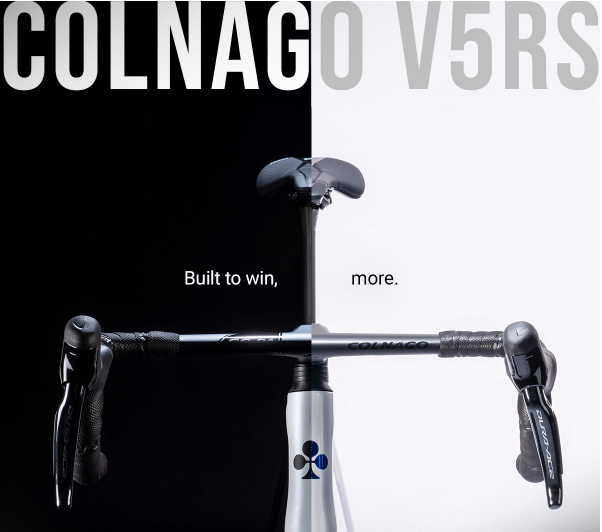
With a decade of experience Colnago’s V series embodies the racing spirit seen with the UAE Team Emirates-XRG and UAE Team ADQ. From their relentless pursuit to improve on the seemingly perfect. Even lighter and more aerodynamic, the V5Rs is the ultimate all-rounder road-racing bike.
Every great story needs a new chapter, and the V5Rs are ready to write new pages of success
Through new lamination and manufacturing techniques. This in combination with FEM Analysis (Finite Element Method) which is a widely used technique which uses mathematical modelling and simulates engineering scenarios and system behaviours, gives the engineers a structural analysis of bicycle frames.
Similar but not Identical, V4Rs vs V5Rs
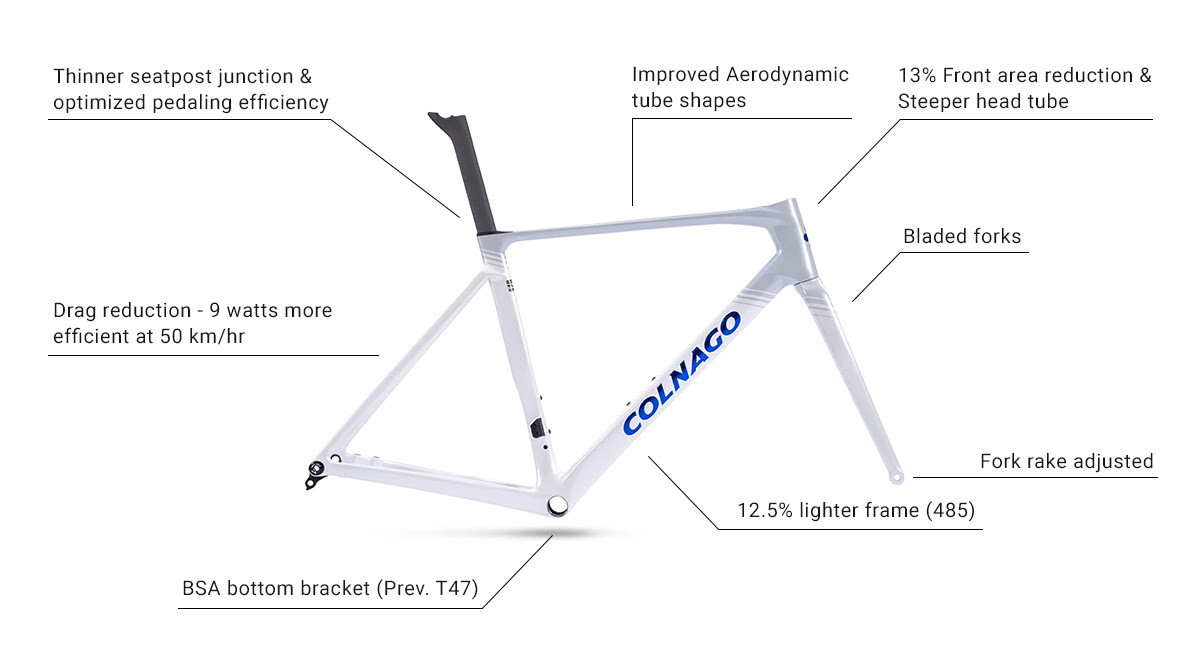
In the process of Colnago’s study into carbon lamination, they improved the precision of the positioning of each layer to achieve an ambitious weight target while maintaining the stiffness properties. Achieving a weight of a size 485 frame, 1027 grams shaving 146 grams from its predecessor and allowing room for 32 mm tyres.
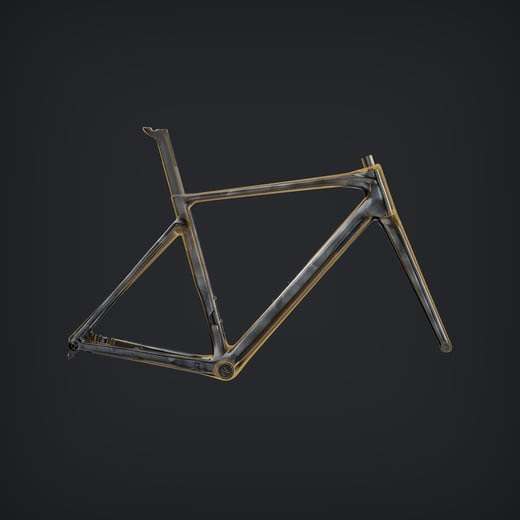
Compared to the V4Rs the V5Rs has slightly higher head tube and seat tube angle to accommodate a more forward orientated and tuck position. As a result, more aerodynamic and better power transmission
Image: Overlapping of the frames of the V5Rs (in dark) and the V4Rs (silhouette in gold)
Return to BSA, Colnago switched from a T47 Bottom bracket in their V4Rs to a BSA bottom bracket, further reducing the weight of the frame, adding more stiffness to the bicycle and allowing the choice of a less oversized bottom solution
More aerodynamic and redesigned tube profiles
The new V5Rs feature three distinct changes to its tubing profile to achieve World Tour Aero status. New fork blade profiles combining light-weight, stiffness and better aerodynamics were the focus for the engineers at Colnago to achieve their lightest bike ever made.
Adopting a thinner head tube and a drastic change up on the seatpost junction, they were able to reduce the weight of the frame and reduce drag. Combine this with a 13% reduction in frontal area the V5Rs require 9 watts less power to maintain speed at 50 km/hr in a real-world racing set-up.
Optimized seat tube joint junction + Front end design
Focus on the lamination process helped balance the stiffness, and adjusting the seat post junction increased the pedal efficiency of the bike while considering the height of the saddle to the bottom bracket. The front end design, where the headtube and down tune are were fine-tuned so as not to deform under steering loads to increase riding precision and handling
For those seeking extreme aerodynamics and maximum responsiveness in a sprint, the Y1Rs is still the ideal choice with the V5Rs close behind.
Optimized seat tube joint junction + Front end design
Focusing on the lamination process helped balance the stiffness and adjusting the seat post junction increased the pedal efficiency of the bike while considering the height of the saddle to the bottom bracket. The front end design, where the headtube and down tune are were fine-tuned so as not to deform under steering loads to increase riding precision and handling
For those seeking extreme aerodynamics and maximum responsiveness in a sprint, the Y1Rs is still the ideal choice, with the V5Rs close behind.